
 Demo
DemoAgent Spotlight - PHMSA Intel Agent
Your Faster, Smarter Way to Navigate PHMSA & Title 49 Regulations
How This Agent Assists You
The PHMSA Intel Agent helps you instantly navigate the complexities of federal transportation and pipeline safety rules by providing:
- Direct, up-to-date PHMSA and Title 49 CFR information - Including hazardous materials (HAZMAT) rules, packaging standards, pipeline integrity requirements, training rules, and safety procedures.
- Fast retrieval of authoritative regulatory text using real-time access and semantic search to surface the most relevant sections - Without digging through hundreds of pages.
- Clear explanations with source citations - Every answer includes direct references and links to official PHMSA or eCFR sections for immediate verification.
- The agent is purpose‑built for PHMSA, HAZMAT, and pipeline safety - Ensuring focused, reliable guidance every time.
Why It's Better
- Instant answers from PHMSA and Title 49 CFR—no more navigating hundreds of pages.
- Real-time, authoritative information powered by semantic search.
- Direct citations and source links for every response.
- Focused expertise on PHMSA, HAZMAT, and pipeline safety—nothing else.
_(1).png)
Industry Insight - AI Driven ERP Modernization in Oil & Gas from Transaction Processing to Intelligent Orchestration
Recent research on skill exposure to automation shows that structured, rule-based, digital workflows are among the most exposed to AI-driven transformation. These workflows form the operational core of oil & gas ERP systems—finance, inventory, compliance, reporting, and reconciliation.
This creates a strategic inflection point:
Oil & gas companies should not merely upgrade ERP systems — they should redesign them around AI agents. The opportunity is to shift ERP from a transactional backbone to an intelligent orchestration platform.
McKinsey's Skill Change Index assesses how automation exposure varies across skills.
.png)
The Structural Exposure in Oil & Gas ERP
Oil & gas ERP environments are disproportionately composed of high-automation-exposure activities:
High Exposure (Immediate AI Opportunity)
- Accounts payable / receivable
- Joint Interest Billing (JIB)
- Revenue distribution
- Inventory reconciliation
- Work order processing
- Regulatory filings (EPA, PHMSA, state production, royalties)
- Contract validation and tariff processing
These processes are:
- Repetitive
- Rules-driven
- Data-consolidation heavy
- Exception-based in nature
They are prime candidates for AI-led automation.
What Changes: The Operating Model
Today:
- Humans process transactions end-to-end
- ERP enforces workflows
- Exceptions are detected manually
- Reporting cycles are slow and fragmented
Future:
- AI agents process transactions autonomously
- ERP serves as system of record
- Humans review only flagged exceptions
- Reporting becomes continuous and real-time
This shift reduces SG&A, accelerates reporting cycles, lowers compliance risk, and improves working capital efficiency.
Board-Level Takeaway
ERP modernization in oil & gas should no longer be framed as a software upgrade initiative.
It is an operating model transformation:
"From systems that record transactions, to systems that reason, validate, and act."
The organizations that move first will redefine cost structures and decision velocity across the industry.
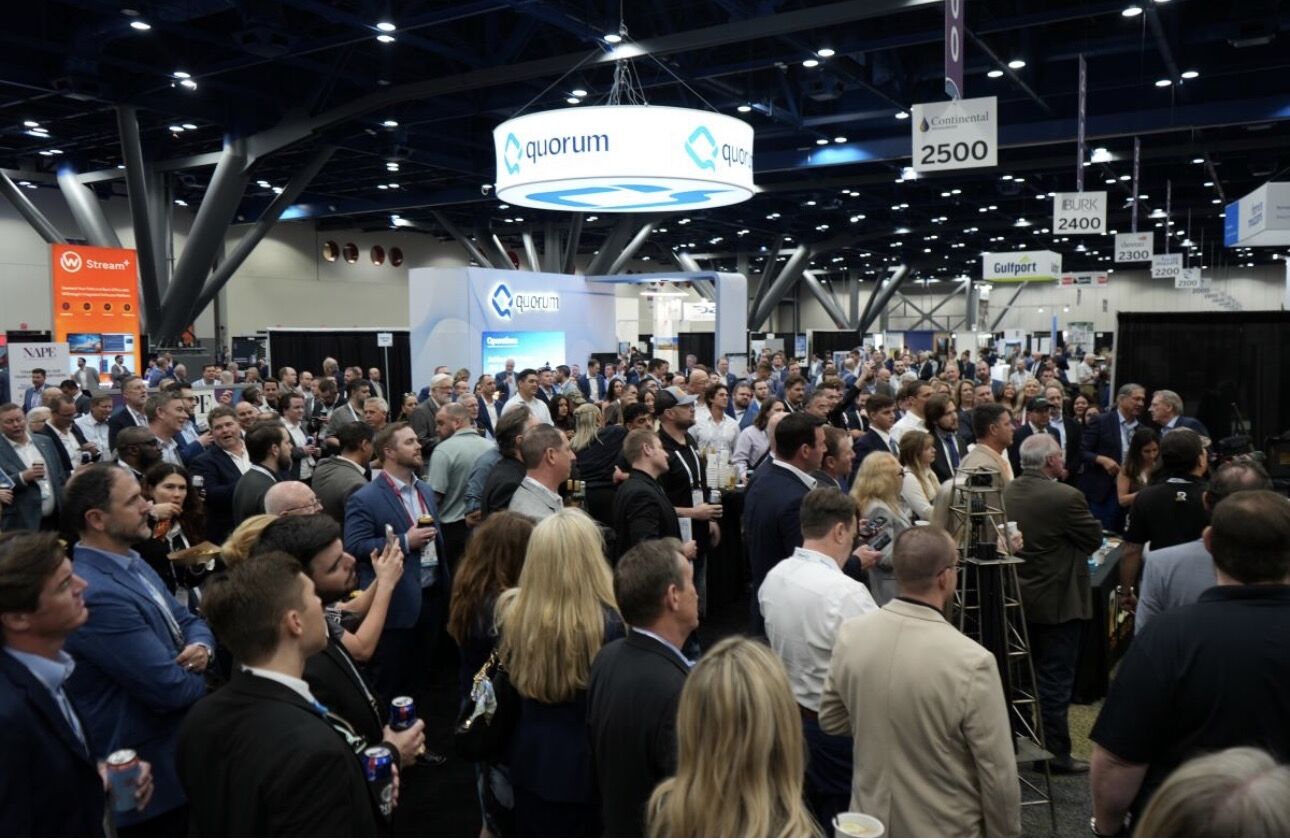
NAPE 2026 - Emerging Perspectives on AI and Efficiency in Energy
Some conversations are planned. Others just happen. One of the most important conversations we had at NAPE started accidentally.
A veteran operator said:
“We keep talking about producing more energy. But what if the real problem is how much we waste?”
Energy is becoming a national treasure, not because we lack resources, but because inefficiency quietly destroys enormous value across operations, compliance, and decision-making. His view is that energy prices would rise as much as 3x in the years ahead.
Another executive added: “AI is both the problem and the solution. It may be the only lever big enough to fix this.”
That exchange stayed with us all week. Because after several days at NAPE, alongside nearly 12,000 operators and industry leaders, one thing became clear: The conversation in energy is changing.
A few patterns stood out:
- Most companies are just getting started - Many are experimenting with chatbots or pilots. Almost everyone is trying to understand what comes next.
- A Rising Sense of Urgency - One early adopter said it best: “Embrace it — or be left behind.”
- The industry wants proof — not promises. Executives asked for education, real use cases, and measurable outcomes. Concepts and demos aren’t enough anymore.
- Innovation is coming from the field - Some of the best AI ideas are coming from teams solving problems every day.
- Skepticism remains healthy - Questions around reliability, security, and ROI are real. But so is the pressure to act. Standing still increasingly feels like the bigger risk.